
Autonomous Systems Engineer Role, Skills, and Job Types
Learn what an autonomous systems engineer does, the core skills needed, and the job titles that use this role today.
By David Nix
Published

An autonomous systems engineer builds machines or software that sense their environment, decide on an action, and carry it out with little or no human input. That broad definition is why the title shows up in three very different worlds: robotics labs building self-driving delivery bots, car companies working on highway autopilot, and software teams building AI agents that plan tasks and call tools on their own. A robotics-focused version of this job might spend the day tuning sensor fusion code in C++. A software-focused version might spend the day writing orchestration logic for an LLM agent in Python.
The daily work changes a lot depending on which industry hired you, even when the job title on the offer letter reads the same. Someone building self-driving perception systems cares about lidar data, real-time constraints, and hardware testing. Someone building agentic AI products cares about prompt design, tool calls, memory, and getting a language model to finish a multi-step task without going off the rails. Both get called an autonomous systems engineer, and both get lumped in with related titles like AI agent engineer or robotics software engineer on job boards. Knowing which flavor a posting actually means, before you apply, saves you from chasing a role that has nothing to do with the skills you've built.
Table of Contents
Where This Job Title Actually Shows Up
Five industries post the bulk of autonomous systems engineer openings: robotics, defense, automotive, logistics, and AI software. Each one hires for a different mix of hardware and code, so the title covers everything from drone guidance work to agent orchestration for a SaaS product.
Hardware-leaning roles sit closer to the physical machine. These jobs involve sensor fusion, control loops, and testing on actual robots, drones, or vehicles, and they often ask for C++ along with real-time systems experience. NASA's systems engineering case studies show how deep this hardware-and-control discipline runs in aerospace and defense work, where a single control failure can ground a whole program (NASA systems engineering case studies).
Software-leaning roles look more like a modern AI engineering job. The work shifts toward agent frameworks, tool calling, and LLM orchestration, and it overlaps heavily with titles like Applied AI Engineer or AI Infrastructure Engineer on job boards that track agentic AI roles specifically.
- Robotics and defense: perception, control systems, hardware-in-the-loop testing
- Automotive: driver-assist and autopilot software, sensor integration
- Logistics: warehouse robots, routing software, fleet autonomy
- AI software: LLM agents, tool orchestration, multi-step task planning
| Industry | Typical focus | Example employer type |
|---|---|---|
| Robotics/defense | Sensors, control, hardware testing | Robotics manufacturer, defense contractor |
| Automotive | Driver-assist, autopilot stacks | Car maker, autonomy supplier |
| Logistics | Warehouse and fleet robotics | Supply chain or delivery company |
| AI software | Agent orchestration, LLM tool use | AI product or platform company |
What the Job Actually Involves Day to Day
Most of the work splits into four buckets, no matter which industry hired you. You write the logic that lets a system pick an action without someone approving it first, you build the pipeline that feeds that logic real data, you test the whole thing before it touches anything real, and you fix it when it breaks in the field.
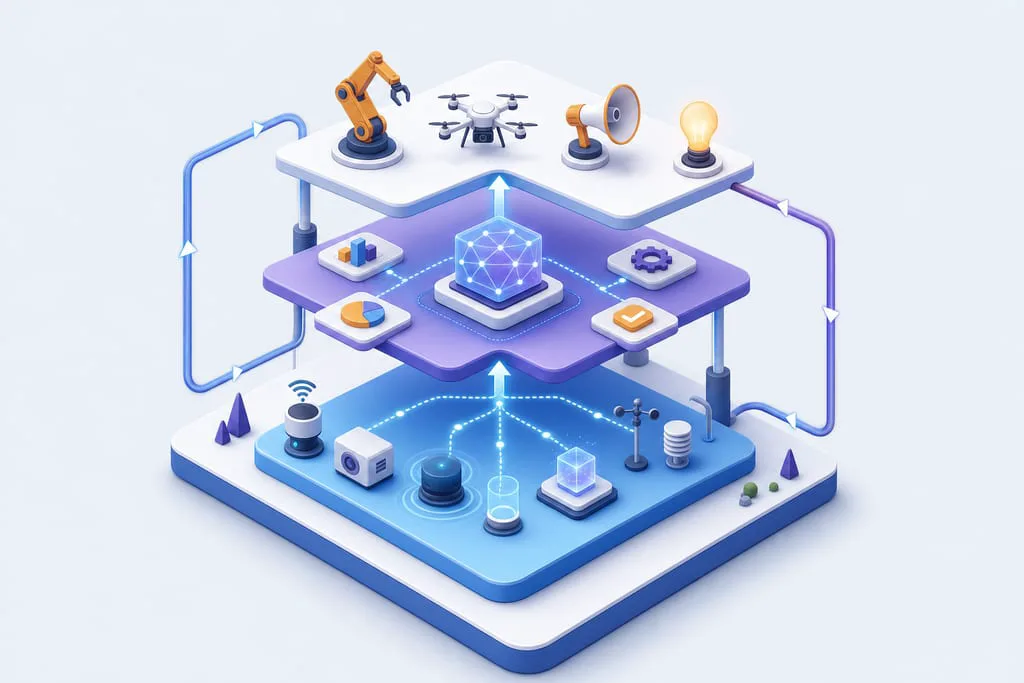
Decision logic is the part that separates this job from regular software work. A robotics engineer writes rules or models that choose a path or a maneuver; an AI software engineer writes the planning loop that lets an agent decide which tool to call next. Either way, the system has to act on its own, and the code has to handle the case it was never tested on.
Perception and data-input work looks different depending on the system. A hardware team pulls in lidar, camera, or radar feeds and fuses them into one picture. A software team pulls in documents, API responses, or user input and turns that into something an LLM agent can reason over.
Simulation comes before anything goes live, and most teams treat this as a hard rule, not a suggestion. A self-driving stack runs thousands of simulated miles before a single real mile. An agent gets run against an evaluation set before it touches a production workflow.
- Build or tune the decision logic that picks an action
- Stand up the sensing or data pipeline the logic depends on
- Run the system in simulation or a staging environment first
- Watch production behavior and patch failures as they show up
Monitoring is the part nobody skips. When autonomous behavior goes wrong, someone has to catch it fast, trace why the system made the call it did, and ship a fix before the next run.
Core Skills Hiring Managers Screen For
Hiring managers screen for a split skill set that depends on whether the system is physical or software-based, and most postings make that split obvious in the first paragraph. Python and C++ show up across almost every version of this job, since both control code and orchestration code need a language that handles real-time or near-real-time demands.
Hardware-leaning postings ask for control theory, sensor fusion, and robotics frameworks like ROS. These skills show up because a physical system has to react to the real world in milliseconds, and a bad control loop can crash a robot or a vehicle.
Software-leaning postings ask for AI agents, large language models, and orchestration tools instead. These roles lean on the same skill list you'd see on an Applied AI Engineer or AI Infrastructure Engineer posting on a job board built around agentic AI roles, including RAG pipelines and tool-calling frameworks.
- Python or C++ for core system logic
- Sensor fusion or control theory for hardware roles
- Agent orchestration or LLM tooling for software roles
- Cloud deployment and API development across both tracks
- Systems architecture knowledge for scaling either version
Cloud deployment, API development, and systems architecture cross both tracks. A robotics engineer still needs to get telemetry into a cloud dashboard, and an AI agent engineer still needs to design the database and API layer the agent runs on top of.
Job Titles That Use This Exact Skill Set
The generic title "Autonomous Systems Engineer" covers only part of the postings that use this skill set, so searching that phrase alone misses roles worth applying to. The exact title appears most in robotics, defense, and automotive job listings, where the work stays close to hardware and control loops.
AI Infrastructure Engineer and Applied AI Engineer cover the software-agent side of the same skill set. These titles describe people building the compute platforms, orchestration tools, and agent pipelines that run the decision logic without any physical hardware attached.
Forward Deployed Engineer shows up when an autonomous system needs custom work inside a specific customer's environment. This title covers integration and deployment, not core system design, so expect more client contact and less greenfield building.
Inference Engineer covers the production serving side, handling the latency, throughput, and quantization work that keeps an autonomous AI model running fast once it's live.
- Autonomous Systems Engineer: robotics, defense, automotive
- AI Infrastructure Engineer: compute platforms and orchestration
- Applied AI Engineer: RAG pipelines and agent integrations
- Forward Deployed Engineer: customer-side customization and deployment
- Inference Engineer: model serving, latency, and throughput in production
A role-based search beats a title-only search here, since the same job can appear under five different titles depending on who wrote the posting.
How to Position Your Background for This Role
Your resume needs to match the flavor of the job you're applying for, not just the generic title. Robotics grads should lead with simulation work and any project that made it from a test rig to a real deployment, since that jump is exactly what hiring managers want proof of.
Backend engineers moving into this space should highlight API design and orchestration experience, since that's the closest match to what an AI Infrastructure Engineer or Applied AI Engineer posting is screening for. Time spent building service-to-service communication or workflow orchestration counts, even if you never touched a model.
ML engineers should pull forward any project involving agents, RAG, or tool-use, since that's the exact overlap hiring managers look for on an autonomous systems posting that's really an agentic AI role in disguise. A side project where an LLM calls external tools counts more here than a pure model-training project.
- Robotics background: lead with simulation-to-deployment projects
- Backend background: lead with API and orchestration work
- ML background: lead with agent, RAG, or tool-use projects
- Any background: match resume wording to the posting's exact title
Tailoring the language to the specific title in the posting matters more than people think. A board that organizes jobs by role definition, the way AI Engineer Jobs splits Applied AI Engineer from AI Infrastructure Engineer from Forward Deployed Engineer, makes this match-up easier than guessing from a generic title alone.
Which Version of This Job You Should Actually Chase
The title keeps splitting because agentic AI growth is pulling it toward software, fast. Companies hiring for agent orchestration and tool-calling work often post under "Autonomous Systems Engineer" because the phrase sounds senior and technical, even when the job has zero sensors or robots attached. That pull is strongest at AI product companies, weakest at defense contractors and car makers.
Hardware robotics roles still use the same title, but the required skills barely overlap with the software version. A defense contractor posting "Autonomous Systems Engineer" wants control theory and hardware-in-the-loop testing. A SaaS company posting the same title wants someone who can wire an LLM into a planning loop. Reading the required skills list tells you which job you're actually looking at faster than reading the title does.
Searching by title alone misses postings that use a different name for identical work. A company building an AI agent that books meetings and files expense reports might call that role "Applied AI Engineer," "AI Infrastructure Engineer," or "Autonomous Systems Engineer" depending on who wrote the listing. Filtering by skill and role definition catches all three, where a title-only search only catches one.
| Search approach | What it catches | What it misses |
|---|---|---|
| Title search only | Postings that use the exact phrase | Same job under a different name |
| Skill-based search | Python, agents, RAG, orchestration terms | Nothing relevant, but adds noise from unrelated roles |
| Role-definition search | Jobs matching a defined function, any title | Postings with vague or missing descriptions |
A board that organizes by role definition instead of raw title text, the way AI Engineer Jobs separates Applied AI Engineer from AI Infrastructure Engineer from Forward Deployed Engineer, surfaces listings a plain title search drops. That matters most for software-leaning candidates, since their target jobs get scattered across the widest range of titles.
Pick a Role Definition and Search That Instead
Go to a job board and search by what the role actually does, not the exact words "Autonomous Systems Engineer." Pull up the Applied AI Engineer, AI Infrastructure Engineer, or Forward Deployed Engineer category based on the skill mix you'd lead with, then check each listing against the skills it names, not just the title at the top. AI Engineer Jobs checks listed skills against the actual posting, so a Python and RAG-heavy listing won't quietly turn out to need ROS and control theory once you open it. Open five listings in that category right now and read the required skills before you read the title again. That's the check that tells you whether a posting is worth your time.
Common Questions About Autonomous Systems Roles
Do I need a robotics degree to get hired for an AI agent version of this job?
No, a robotics degree is not required for the software-leaning version of this role. Companies hiring for agent orchestration and LLM tool-calling care about Python, API design, and experience shipping agents that complete multi-step tasks. A computer science degree or a self-taught background with real agent projects carries more weight than a robotics credential for that track.
Is an autonomous systems engineer just a machine learning engineer with a different title?
No, the two jobs overlap but are not the same. A machine learning engineer usually trains, evaluates, and tunes models. An autonomous systems engineer builds the decision loop and the pipeline around a model or control system so it can act without a human approving each step, which is a systems and orchestration job more than a pure modeling job.
Can an embedded systems background transfer into agentic AI work?
Yes, embedded systems experience transfers, but the match is partial. Real-time constraints, sensor-to-decision pipelines, and failure handling under tight timing all carry over to agent systems, where latency and reliability matter just as much. The gap is on the software side, since you'll need to pick up orchestration frameworks, tool-calling patterns, and LLM-specific evaluation work that embedded roles don't touch.
How do I find the agentic AI version of this job without wading through hardware robotics postings?
Search by role definition instead of job title. A board like AI Engineer Jobs splits listings into categories such as Applied AI Engineer and AI Infrastructure Engineer, so you can pull up the software-side skill mix directly instead of opening dozens of "Autonomous Systems Engineer" postings to find out which ones mean robotics and which mean agents.